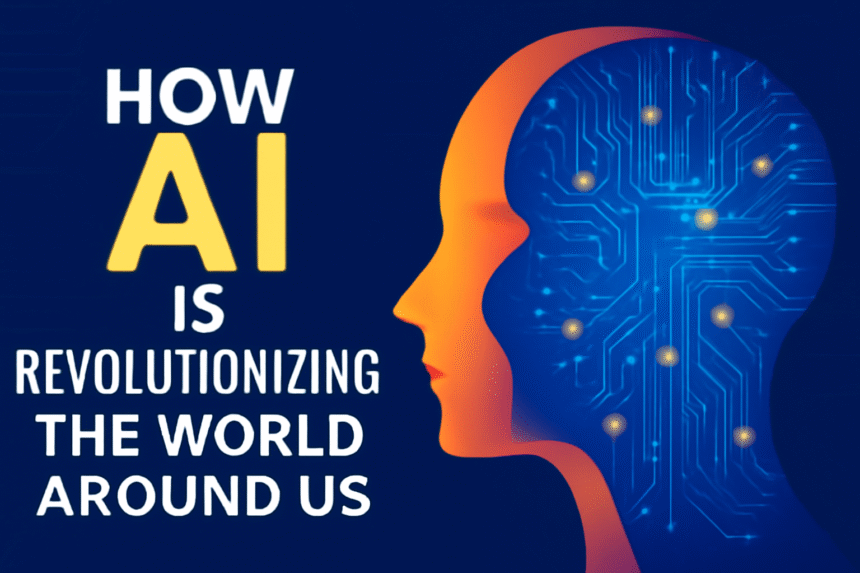
How AI is Revolutionizing the World Around Us
AI is no longer a pipe dream; it is here today, transforming the way we go about our lives and connect with the world. AI has advanced rapidly in recent years, affecting businesses throughout the world such as healthcare, banking, education, transportation, and others.
- How AI is Revolutionizing the World Around Us
- What is Artificial Intelligence?
- 1. AI in Healthcare: Transforming Patient Care
- 2. AI in transportation: Self-driving cars and intelligent cities
- 3. AI in Education: Personalizing Learning
- 4. AI in Business: Automation and Efficiency
- 5. AI in Entertainment: Personalizing Content
- 6. AI in Agriculture: Optimizing Food Production
- Conclusion
In this piece, we’ll look at how artificial intelligence is transforming our environment and why many people believe it’s the next great step in technological growth. AI has changed everything, especially simple tasks to difficult challenges.
What is Artificial Intelligence?
Artificial intelligence is the process of duplicating human thinking and behavior using computers. This contains language understanding, learning, reasoning, problem solving, or perception. AI comes in many forms, including
Narrow AI
Also called weak AI, is a type of AI that is made to do one job or a small number of jobs. For instance, AI is used in voice assistants like Siri and Alexa, as well as in Netflix and YouTube’s recommendation algorithms.
General AI
Strong AI, often known as advanced AI, can do every mental task that a human does. AI researchers are working toward this aim, which is still in the works.
Superintelligent AI
Is an AI that is smarter than humans in every way. We haven’t gotten there yet, but both scientists and philosophers are intrigued in the idea.
Now, let’s look at how AI is changing the world in different sectors.
1. AI in Healthcare: Transforming Patient Care
What artificial intelligence has done for medical care is nothing short of amazing. AI supports healthcare workers make better diagnosis, personalize treatments to each patient, and find faster answers to tough medical issues.
- As of now, AI systems can correctly look at medical pictures such as MRIs and X-rays. A Google program called DeepMind is said to be better and faster at finding diseases like cancer by researchers.
- For each patient, AI might be able to make a unique treatment plan based on their genes, medical background, and way of life. There are better medicines that work better for everyone because of this. This means better results with fewer side effects.
- Robotic Surgery: Artificial intelligence permits doctors to perform complicated operations more precisely. These robots can interpret massive amounts of data in real time for surgeons, making procedures less invasive and more efficient.
AI applications in healthcare are among the most transformative because they save lives, reduce medical costs, while enhancing results for patients.
2. AI in transportation: Self-driving cars and intelligent cities
AI is changing not only how we drive, but also how we think about getting around in general. One of the most obvious ways that AI is changing transportation is with self-driving cars.
- Self-driving cars: Companies like Tesla, Waymo, and Uber are using AI to make cars that can drive themselves, read road signs, and avoid obstacles without any help from a person. This could make the roads safer, cut down on traffic, and lower the number of people who die in car accidents.
- The use of artificial intelligence (AI) in smart cities has the potential to greatly improve traffic flow. By analyzing real-time data from vehicles, sensors, and cameras, AI systems may one day be able to reduce traffic congestion, enhance the timing of traffic signals, and even alter traffic patterns after an accident.
- With the help of AI technologies that guess how many people will use it, find the best routes, and give real-time information, public transportation works better. This might be good for the environment and make going to the city easier.
AI will run smart cities in the coming years. These cities will be better for traffic, safety, and general economy.
3. AI in Education: Personalizing Learning
AI is also making big changes to how we learn. With AI, learning can be tuned to each child, which helps them do better in school.
- Each of the DreamBox and Knewton devices can learn in its own way. AI is used to make learning tools that work well for every class. Each student can learn in their own way, which means they can go at their own speed.
- Tutoring powered by AI: Virtual teachers who use AI can help students with their homework, give them comments in real time, and walk them through hard topics. This makes it easier to learn and makes it more specialized.
- Grades that are given without any help: AI can help teachers grade papers, which normally takes a lot of time. With Gradescope and other tools, teachers can quickly grade papers and tasks. This provides them additional time to work with their groups.
AI is making schools better because it gives students more chances to do well and gives teachers more time to help students learn.
4. AI in Business: Automation and Efficiency
AI is affecting ways that businesses sell and promote goods.
- HubSpot and Salesforce are two systems that employ AI to figure out what consumers are likely to purchase based on information they have about them. These platforms also make sure that each customer’s marketing is unique to them. This helps salespeople be more focused and make more sales.
- In predictive analytics, AI can look at market trends and data from the past to guess what will happen next. This is very helpful for businesses in banking, shopping, and transportation that need to guess what customers will do or how the stock market will move.
- AI is helping businesses be more competitive and efficient by simplifying tasks, making people smarter, and giving customers experiences that are unique to them.
5. AI in Entertainment: Personalizing Content
AI is changing the entertainment business by making tailored content suggestions and even coming up with new kinds of entertainment:
- Recommendation engines are algorithms powered by artificial intelligence that make movie, song, and video recommendations on websites like YouTube, Netflix, and Spotify. These algorithms look at what you like and suggest things that you may like.
- AI-Generated Content: AI is additionally utilized to create illustrations, music, and scripts. Amper Music and OpenAI’s GPT-3 are two AI tools capable of producing engaging stories and music.
- AI for gaming: AI is also being used to improve video games by, for example, having NPCs behave more like actual people and generating dynamic game landscapes. AI is utilized to generate dynamic, ever-changing landscapes in video games like No Man’s Sky and Minecraft.
The future of entertainment will be even more fun and immersive because AI can create experiences that are unique to each individual.
6. AI in Agriculture: Optimizing Food Production
AI helps farmers improve their practices, contributes to solutions to global issues like food security and sustainability, and boosts food production.
- AI tools such as IoT and drones can help farmers monitor their crops, weather, and land in real time. This type of farming is known as precise farming. They can use this data to plan when to plant, water, and feed their crops, which helps them get more and lose less.
- AI in Pest Control: AI systems can identify pests and diseases in crops, allowing producers to apply medications only when needed. This offers greater benefits for the environment.
- Robotic Harvesting: AI-powered robots are being made to help in harvesting crops. This will cut down on the cost of manpower and make the process more efficient.
AI is helping farmers grow food in a more sustainable way and with better quality by making things more efficient and cutting down on waste.
Conclusion
Artificial intelligence advancements are causing adjustments in the world that used to be considered science fiction. AI is increasing efficiency in transportation, business, entertainment, and healthcare, therefore improving our quality of life and helping to the settlement of major global concerns. With the advancement of technology, it appears to be capable of doing almost any work.
As AI grows more popular, it is critical to ensure that technology is used safely. To guarantee that AI helps everyone, it is critical to address ethical problems such as AI bias, data privacy, and job displacement. It is critical to strike a balance between encouraging innovation and preserving accountability, ensuring that AI works to help rather than replace people.